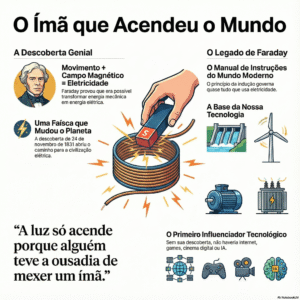
🎯 “Light only switches on because someone was bold enough to move a magnet.”
💡 Historical & Scientific Context
Faraday, a totally self-taught physicist, basically got obsessed with the idea that electricity and magnetism might actually be the same thing.
After way too many experiments, questionable sketches, and a ridiculous number of coils, he lands on this:
⚙ Movement + Magnetic Field = Electricity Generated
This is the principle behind:
- hydropower plants,
- wind turbines,
- backup generators,
- transformers,
- electric motors,
- and basically EVERYTHING holding our modern world together.
Faraday didn’t just create a law.
He wrote the instruction manual for electrical civilization.
The Law of Induction is perfect for creative learning because.
✔ It proves massive revolutions start from simple ideas
Faraday waved a magnet → a spark popped → the planet changed.
✔ It is pure scientific storytelling
A whole journey of curiosity, persistence, and messy experiments.
✔ It is applied innovation
Every young creator needs to get that making things “spin” — ideas, projects, processes — literally generates energy.
✔ It plugs directly into the creative-economy curriculum
No electricity?
No gaming, no internet, no digital music, no cinema, no AI, no StoryMode.
Faraday is basically the first big tech influencer in history.
Reward of the Day
Understanding that innovation is a motor — and motors only work when something actually moves.
📚 GLOSSARY
-
Electromagnetic Induction: The process where a changing magnetic field generates electric current.
-
Magnetic Field: Region where magnetic forces act; essential to motors and generators.
-
Coil: Wound wire used to generate or capture electrical energy.
-
Generator: Machine that turns motion into electricity.
-
Faraday: English physicist (1791–1867), one of the founding parents of modern electricity.
-
Electricity: Movement of electric charges; foundation of modern technology.
-
Scientific Innovation: Ideas that transform knowledge into real-world impact.
🧠 EdTech.Cool StoryMode Stamp
-
Bloom: Apply / Analyze
-
UNESCO: Science + Technology + Curiosity
-
OECD: Problem Solving, Innovation, Scientific Reasoning
-
ISTE: Computational Thinker + Knowledge Constructor
💬 PBL Tip for Educators
Ask students to create a visual metaphor for electromagnetic induction — could be a drawing, animation, collectible card, model, or even a short performance scene.
Afterwards, each team explains “what moves” and “what transforms.”
It is science, but with full storytelling. -